 Logistics operations
See the exception. Own the next move.
Turn fragmented carrier events into an owned exception queue with evidence, next actions and controlled updates.
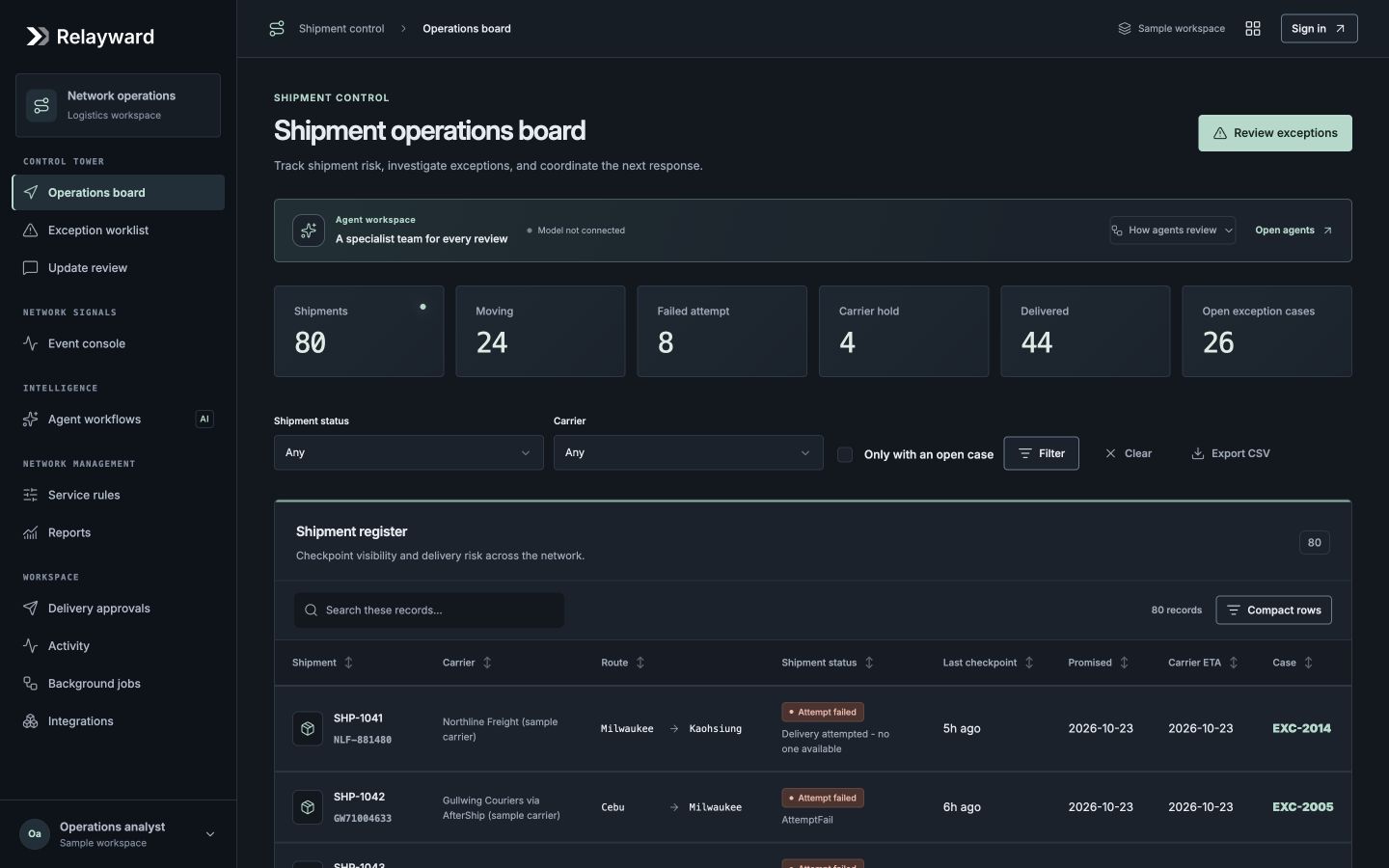
A record. Four handoffs.
A decision you can inspect.
Choose a scenario and advance through the workflow. Every output below is a prepared example tied to the displayed sample record.
Workflow explorer / Save an internal exception updateMilwaukee → Kaohsiung
Source evidence
- Shipment
- SHP-1041
- Customer
- Harbor & Pine Goods customer #140
- Carrier status
- attempt failed
- Exception
- failed attempt
- Promised by
- 2026-10-23
- Latest checkpoint
- attempt failed · Kaohsiung · 2026-10-21T04:00:00.000Z
Specialist handoffs
Ready to explore- 1Event analyst
SHP-1041 has 4 normalized checkpoint(s). Current recorded status: attempt failed.
Prepared sample output - 2Exception analyst
The case is flagged for failed attempt. Compare event time with the service commitment; an estimated arrival is not proof of delivery.
Prepared sample output - 3Recovery planner
Assign an owner and review the triggering checkpoint
Prepared sample output - 4Operations reviewer
Keep the update internal until an operator verifies the carrier facts. Do not claim a carrier has been contacted or a parcel delivered.
Prepared sample output
Save an internal exception update
Example draftSHP-1041: failed attempt. Recorded status: attempt failed. Next action: Assign an owner and review the triggering checkpoint. Delivery and recovery timing require verified carrier evidence.
This walkthrough creates an internal update only. It does not contact a carrier, send a customer message, or change a delivery status.
Milwaukee → Kaohsiung
Source evidence
- Shipment
- SHP-1041
- Customer
- Harbor & Pine Goods customer #140
- Carrier status
- attempt failed
- Exception
- failed attempt
- Promised by
- 2026-10-23
- Latest checkpoint
- attempt failed · Kaohsiung · 2026-10-21T04:00:00.000Z
Specialist handoffs
Ready to explore- 1Event analyst
SHP-1041 has 4 normalized checkpoint(s). Current recorded status: attempt failed.
Prepared sample output - 2Exception analyst
The case is flagged for failed attempt. Compare event time with the service commitment; an estimated arrival is not proof of delivery.
Prepared sample output - 3Recovery planner
Assign an owner and review the triggering checkpoint
Prepared sample output - 4Operations reviewer
Keep the update internal until an operator verifies the carrier facts. Do not claim a carrier has been contacted or a parcel delivered.
Prepared sample output
Save an internal exception update
Example draftSHP-1041: failed attempt. Recorded status: attempt failed. Next action: Assign an owner and review the triggering checkpoint. Delivery and recovery timing require verified carrier evidence.
This walkthrough creates an internal update only. It does not contact a carrier, send a customer message, or change a delivery status.
Penang → Fort Wayne
Source evidence
- Shipment
- SHP-1051
- Customer
- Mosswood Outfitters customer #150
- Carrier status
- in transit
- Exception
- stalled
- Promised by
- 2026-10-24
- Latest checkpoint
- in transit · Tulsa · 2026-10-16T09:00:00.000Z
Specialist handoffs
Ready to explore- 1Event analyst
SHP-1051 has 2 normalized checkpoint(s). Current recorded status: in transit.
Prepared sample output - 2Exception analyst
The case is flagged for stalled. Compare event time with the service commitment; an estimated arrival is not proof of delivery.
Prepared sample output - 3Recovery planner
Contact carrier for trace
Prepared sample output - 4Operations reviewer
Keep the update internal until an operator verifies the carrier facts. Do not claim a carrier has been contacted or a parcel delivered.
Prepared sample output
Save an internal exception update
Example draftSHP-1051: stalled. Recorded status: in transit. Next action: Contact carrier for trace. Delivery and recovery timing require verified carrier evidence.
This walkthrough creates an internal update only. It does not contact a carrier, send a customer message, or change a delivery status.
Johor Bahru → Cebu
Source evidence
- Shipment
- SHP-1060
- Customer
- Quill & Ember customer #159
- Carrier status
- in transit
- Exception
- delivery window
- Promised by
- 2026-10-18
- Latest checkpoint
- in transit · Lyon · 2026-10-21T06:00:00.000Z
Specialist handoffs
Ready to explore- 1Event analyst
SHP-1060 has 3 normalized checkpoint(s). Current recorded status: in transit.
Prepared sample output - 2Exception analyst
The case is flagged for delivery window. Compare event time with the service commitment; an estimated arrival is not proof of delivery.
Prepared sample output - 3Recovery planner
Contact carrier for trace
Prepared sample output - 4Operations reviewer
Keep the update internal until an operator verifies the carrier facts. Do not claim a carrier has been contacted or a parcel delivered.
Prepared sample output
Save an internal exception update
Example draftSHP-1060: delivery window. Recorded status: in transit. Next action: Contact carrier for trace. Delivery and recovery timing require verified carrier evidence.
This walkthrough creates an internal update only. It does not contact a carrier, send a customer message, or change a delivery status.
The product is built.
Your environment is specific.
The public sample makes no carrier calls and sends no customer updates. It uses the product’s fictional shipment and checkpoint records.
A client implementation requires its own system connections, policy configuration, model credentials and acceptance testing. The walkthrough is a public, browser-only slice of the workflow.
Read the implementation case