A tracking event is not a resolution.
Turn fragmented carrier events into an owned exception queue with evidence, next actions and controlled updates.
 Built by Tern & LoomIllustrative operating scenario
This describes a Tern & Loom product implementation using fictional business data. It is not a client engagement, testimonial, or measured customer result. The website walkthrough uses authored outputs; the operational product contains the agent orchestration and review workflow.
See the exception. Own the next move.
Carrier feeds arrive late, use inconsistent status labels, and do not explain who should act. Operators spend time reconstructing events and sending updates while failed attempts and stalled shipments remain unowned.
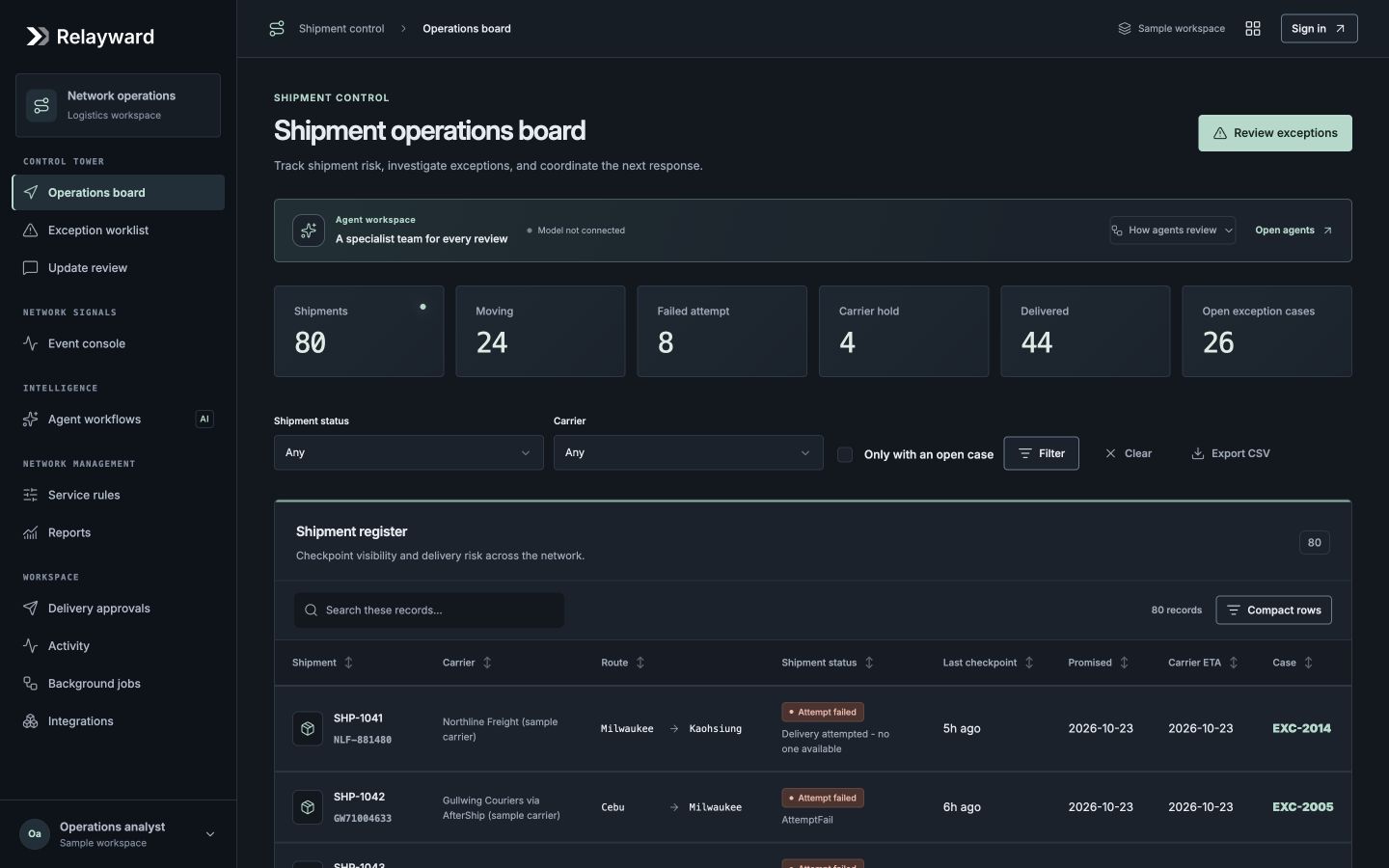
Carrier event normalization and chronology
Commitment-based exception detection
Owner assignment and recovery planning
Evidence-grounded internal and customer updates
Follow the exception.
Inspect a failed delivery attempt, a stalled shipment, and a delivery-window exception. The walkthrough reconstructs the relevant facts and prepares an internal update while retaining uncertainty about recovery and delivery.
Event analyst
Establish the record and the available evidence.
Exception analyst
Check domain context, sources and constraints.
Recovery planner
Prepare a proposed next step with uncertainty visible.
Operations reviewer
Challenge the proposal before human review.
The product implements these roles with LangGraph orchestration, evidence snapshots and a review gate. This website presents a deterministic walkthrough of that structure; it does not run a model.
- Event time is kept distinct from the time an update was received.
- An ETA is not treated as proof of delivery.
- A generated update cannot claim an unverified carrier contact or resolution.
Define success before rollout.
Establish a baseline from the team’s existing process, run a controlled pilot, and compare like-for-like work. Track exceptions alongside speed.
- Time from exception detection to ownership
- Unowned exception age by carrier and rule
- Accuracy of updates against carrier evidence
No improvement percentages or ROI figures are claimed for this illustrative case.
See the evidence yourself.
Inspect three sample records and work through the review.