An invoice is a document. Paying it is a decision.
Bring invoices, purchase orders, receipts and review decisions into one controlled AP workspace.
 Built by Tern & LoomIllustrative operating scenario
This describes a Tern & Loom product implementation using fictional business data. It is not a client engagement, testimonial, or measured customer result. The website walkthrough uses authored outputs; the operational product contains the agent orchestration and review workflow.
Accounts payable, with a clear line of sight.
A finance team receives invoices through email, compares them with purchase orders, and chases warehouse receipts in separate systems. The slow part is often the exception: a possible duplicate, an unrecorded delivery, or a discrepancy nobody owns.
Document intake and extraction review
Purchase-order and receipt reconciliation
Duplicate and supplier exception handling
Independent approval and controlled bill export
Follow the exception.
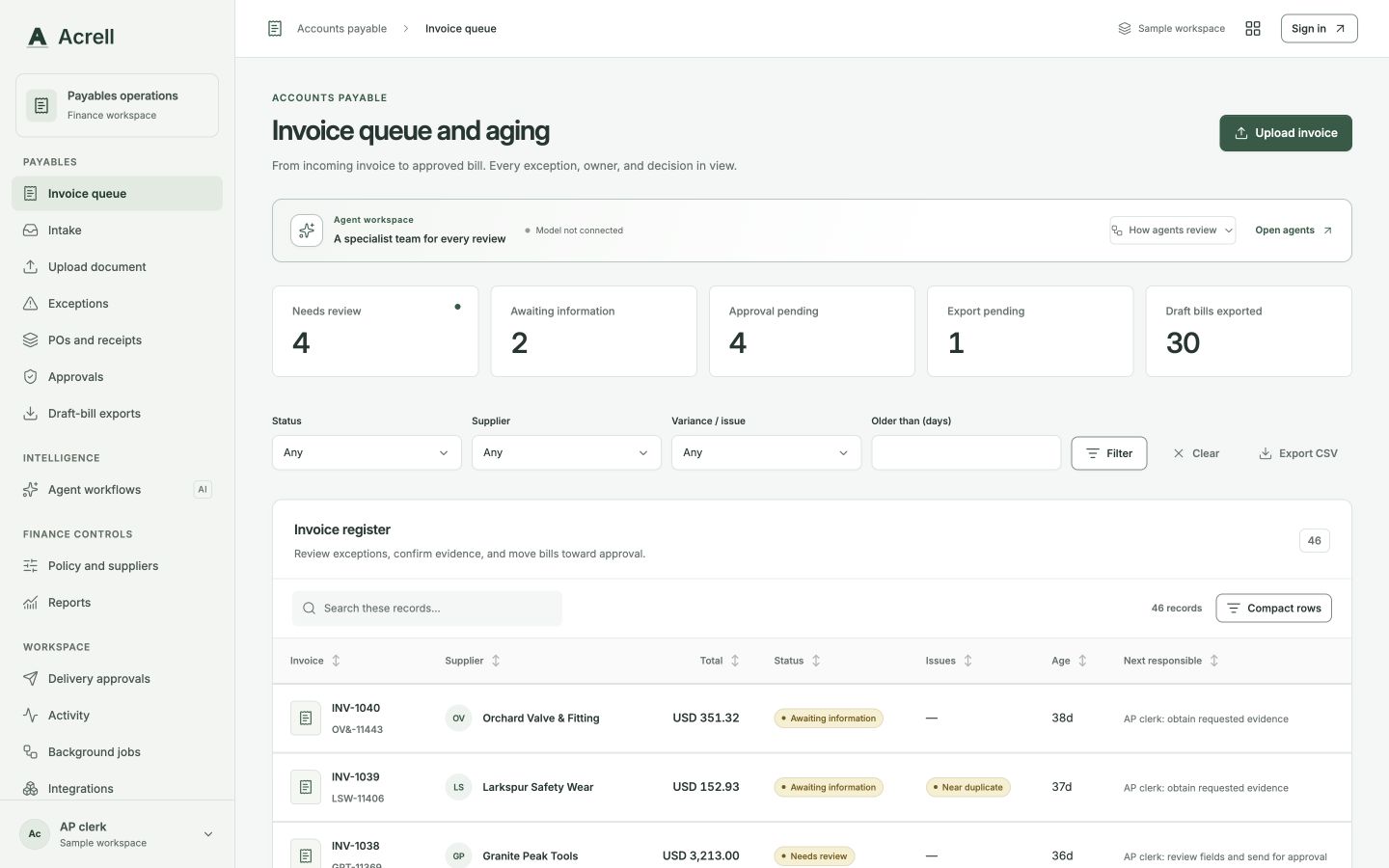
The sample queue contains a $3,213.00 Granite Peak Tools invoice ready for review, a Larkspur Safety Wear invoice flagged as a possible duplicate, and an Orchard Valve & Fitting invoice awaiting information. The useful output is a brief tied to the underlying invoice and purchase order—not an automatic payment.
Document analyst
Establish the record and the available evidence.
Matching analyst
Check domain context, sources and constraints.
AP planner
Prepare a proposed next step with uncertainty visible.
Control reviewer
Challenge the proposal before human review.
The product implements these roles with LangGraph orchestration, evidence snapshots and a review gate. This website presents a deterministic walkthrough of that structure; it does not run a model.
- A missing receipt stays visible; an AI summary cannot clear the hold.
- The person preparing an invoice and the person approving it have distinct responsibilities.
- Changed evidence invalidates prior review rather than silently carrying approval forward.
Define success before rollout.
Establish a baseline from the team’s existing process, run a controlled pilot, and compare like-for-like work. Track exceptions alongside speed.
- Time from intake to a review-ready invoice
- Manual touches per exception type
- Duplicate holds resolved with supporting evidence
No improvement percentages or ROI figures are claimed for this illustrative case.