A fluent answer is not enough. It needs a source.
Account context, authorized knowledge and human review for support teams that need answers they can trace.
 Built by Tern & LoomIllustrative operating scenario
This describes a Tern & Loom product implementation using fictional business data. It is not a client engagement, testimonial, or measured customer result. The website walkthrough uses authored outputs; the operational product contains the agent orchestration and review workflow.
Every answer should have somewhere to stand.
A support team may have plenty of documentation and still struggle to give the right answer. Plan entitlements differ. Knowledge becomes stale. Incident statements change. A confident but unsupported reply creates more work than a careful escalation.
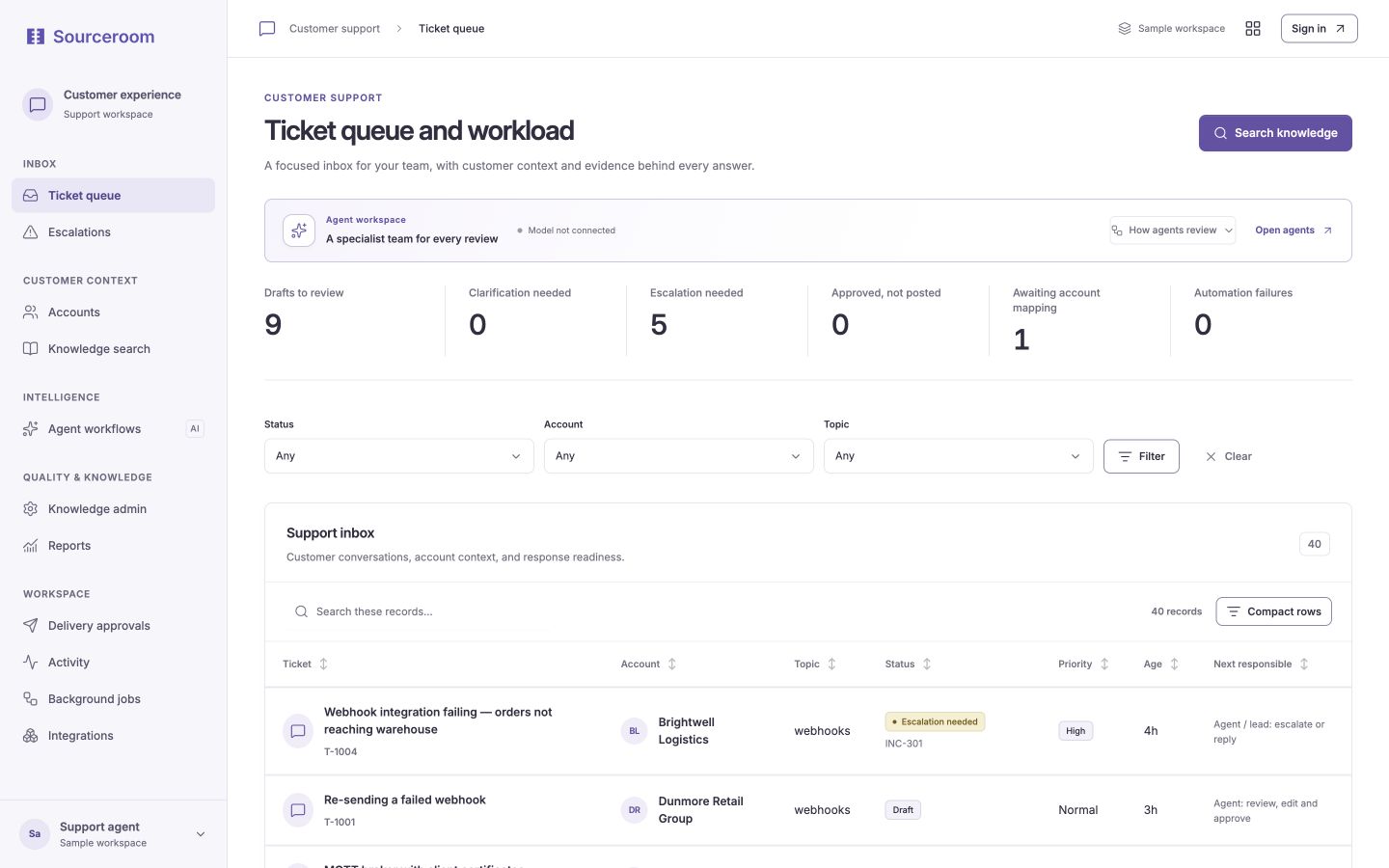
Account-aware ticket triage
Authorized knowledge retrieval and source revisions
Incident-aware drafting and escalation
Reviewer decisions and controlled reply delivery
Follow the exception.
A SAML setup question, a failing warehouse webhook, and an unresolved CSV export limit require different handling. The walkthrough shows why the right outcome may be a constrained draft, an incident escalation, or a request for verified product guidance.
Conversation analyst
Establish the record and the available evidence.
Knowledge analyst
Check domain context, sources and constraints.
Response writer
Prepare a proposed next step with uncertainty visible.
Source reviewer
Challenge the proposal before human review.
The product implements these roles with LangGraph orchestration, evidence snapshots and a review gate. This website presents a deterministic walkthrough of that structure; it does not run a model.
- Customer text is treated as evidence, not instructions to the system.
- Knowledge conflicts and missing sources trigger clarification or escalation.
- Entitlement and source changes invalidate affected review decisions.
Define success before rollout.
Establish a baseline from the team’s existing process, run a controlled pilot, and compare like-for-like work. Track exceptions alongside speed.
- Reviewer acceptance rate for grounded drafts
- Escalation accuracy for unsupported questions
- Time to a supported first response
No improvement percentages or ROI figures are claimed for this illustrative case.
See the evidence yourself.
Inspect three sample records and work through the review.