A maintenance request is a chain of commitments.
Coordinate resident requests, safety escalation, vendor evidence, access and owner approvals in one place.
 Built by Tern & LoomIllustrative operating scenario
This describes a Tern & Loom product implementation using fictional business data. It is not a client engagement, testimonial, or measured customer result. The website walkthrough uses authored outputs; the operational product contains the agent orchestration and review workflow.
The whole job. From the first report to the final check.
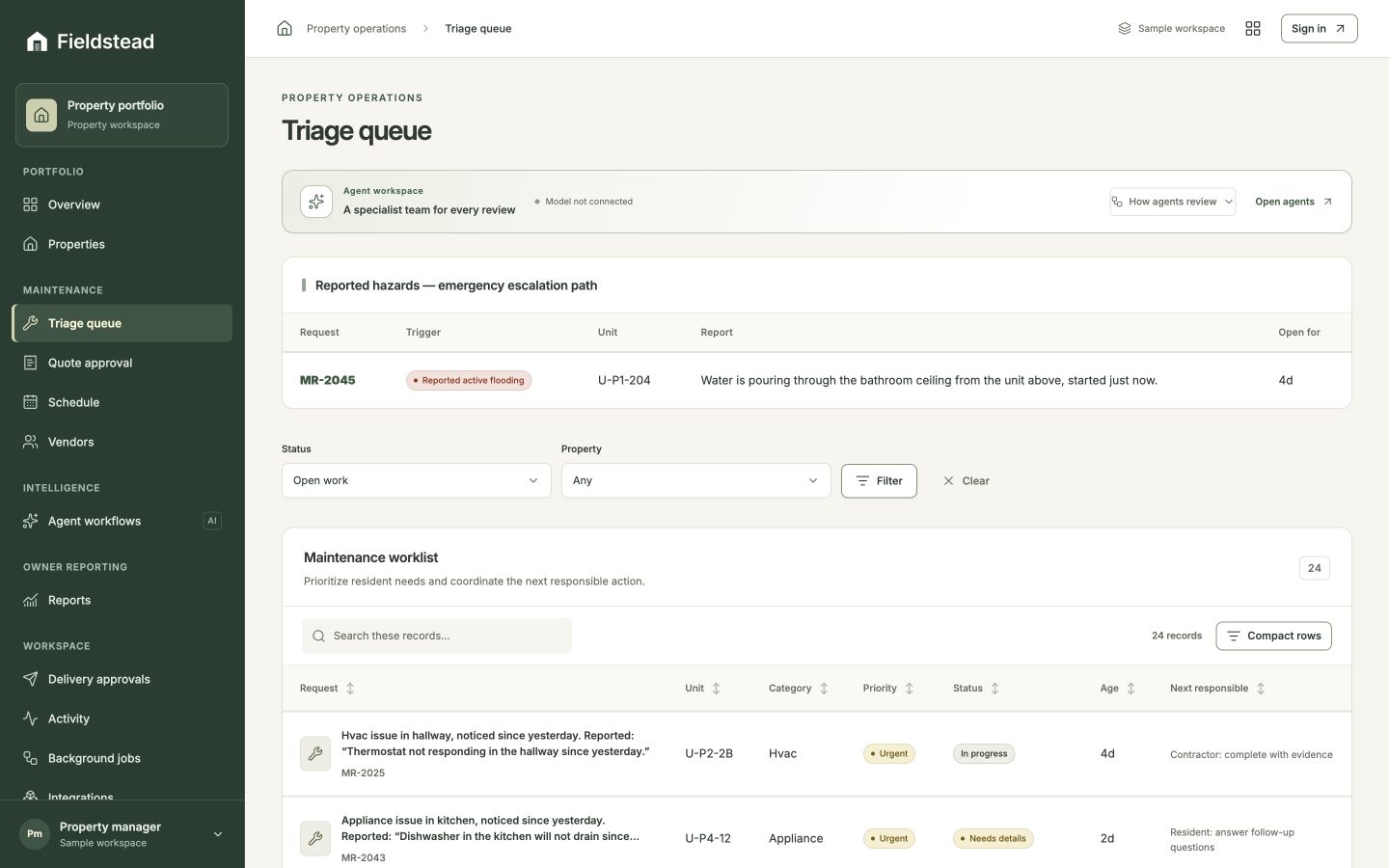
A property manager receives a resident report, finds a suitable vendor, checks access, obtains a quote, and seeks owner approval. When these steps live in messages and spreadsheets, it is difficult to tell what is blocked—or whether someone has made a commitment too early.
Resident intake and hazard escalation
Vendor qualification and access checks
Quote review and owner approval
Scheduling, completion evidence and verification
Follow the exception.
The sample portfolio includes a running toilet waiting for owner approval, a dishwasher job needing a quote, and water entering through a bathroom ceiling. Their priorities and dependencies remain visible throughout the agent handoff; the emergency is never flattened into an ordinary scheduling task.
Intake coordinator
Establish the record and the available evidence.
Vendor coordinator
Check domain context, sources and constraints.
Work planner
Prepare a proposed next step with uncertainty visible.
Property reviewer
Challenge the proposal before human review.
The product implements these roles with LangGraph orchestration, evidence snapshots and a review gate. This website presents a deterministic walkthrough of that structure; it does not run a model.
- A safety classification cannot be reduced by an AI-generated brief.
- Entry permission and vendor qualifications are explicit prerequisites.
- A quote or coordination note cannot authorize spend or book a visit.
Define success before rollout.
Establish a baseline from the team’s existing process, run a controlled pilot, and compare like-for-like work. Track exceptions alongside speed.
- Time from request to a qualified next action
- Requests blocked on access, quote or approval
- Completion-to-verification time
No improvement percentages or ROI figures are claimed for this illustrative case.
See the evidence yourself.
Inspect three sample records and work through the review.